
- Nation
- England
- Pricing region
- East of England
- Postcode areas
- IP, NR, CO, CB
- Main towns
- Ipswich, Lowestoft, Bury St Edmunds, Haverhill, Felixstowe
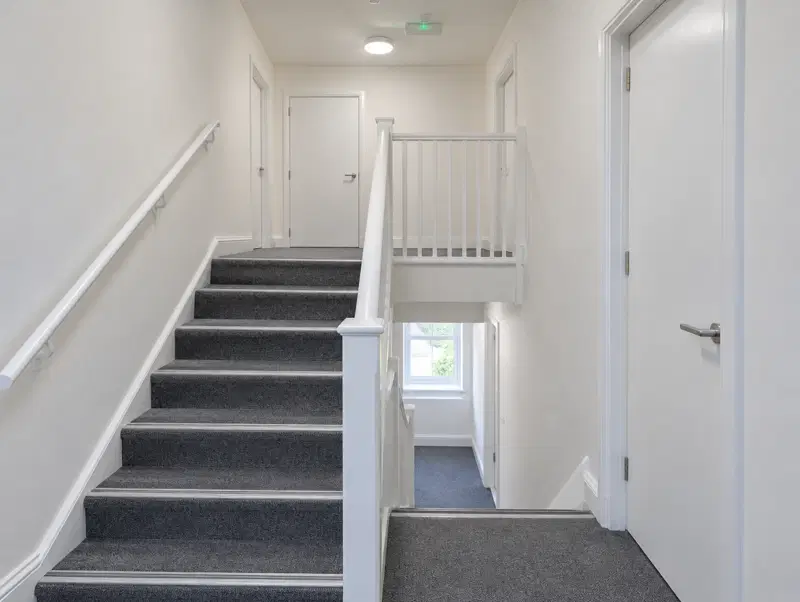
What do escape routes, emergency lighting and fire stopping in Suffolk involve?
- Fire stopping around pipes, cables and voids
- Photo record of hidden fire stopping
- Final exit door with thumb-turn
- Removing fire risks from the route
- Emergency lighting to the route
- Glazing upgrades in doors and fanlights
Which rules apply in Suffolk?
- Smoke alarms on every storey with living accommodation and CO alarms by fixed combustion appliances (other than gas cookers) are required by law.
- Building regulations cover structural changes, new partitions, ensuite drainage, fire-resisting construction and notifiable electrical work.
- Under the Renters’ Rights Act, civil penalties reach £40,000 for offences such as running an unlicensed HMO.
- The Fire Safety Order 2005 applies to the common parts of HMOs, enforced by the fire and rescue authority.
- A conversion can be a material change of use under the building regulations, so confirm with building control before work starts.
Councils in England can add additional licensing and Article 4 directions on top of the national rules. Check the council’s website for the exact address before you buy or start work.
How much do escape routes, emergency lighting and fire stopping cost in Suffolk?
| Item | UK typical | Local guide | Per |
|---|---|---|---|
| Protected route upgrades: fire-resisting linings, fire stopping, lighting (three-storey house, our estimate) | £2,000 – £6,000 | £2,100 – £6,350 | house |
| Emergency light fitting, installed (our estimate) | £150 – £350 | £160 – £370 | fitting |
| FD30S fire door leaf into an existing frame, with seals, closer and hinges, fitted | £300 – £600 | £320 – £640 | door |
Typical time on site: 3–8 working days. For a figure for your house, try the guide-price tool.
Escape routes, emergency lighting and fire stopping by town in Suffolk
Questions about escape routes, emergency lighting and fire stopping in Suffolk
Does every HMO need emergency lighting?
Not every one. Guidance tends to expect it where the escape route is long, complex or has no borrowed light, which is more common in larger houses.
What is fire stopping?
Sealing gaps where pipes, cables and ducts pass through fire-resisting walls and floors, so smoke and fire cannot get through.
Do you carry out escape routes, emergency lighting and fire stopping across Suffolk?
Yes, across the whole of Suffolk, including Ipswich, Lowestoft, Bury St Edmunds.
Who licenses HMOs in Suffolk?
HMOs in Suffolk are licensed by the local council for the address. Where an area has several councils, each runs its own licensing and planning policies.
Other HMO services in Suffolk
- HMO fire safety upgrades in Suffolk
- Fire doors in Suffolk
- Fire alarm and detection systems in Suffolk
- Large HMO conversions (7+ sharers) in Suffolk
- Licence condition and schedule-of-works in Suffolk
- Commercial and above-shop to HMO in Suffolk
- Shared bathroom and shower room refits in Suffolk
- Void and between-tenancy refurbs in Suffolk