
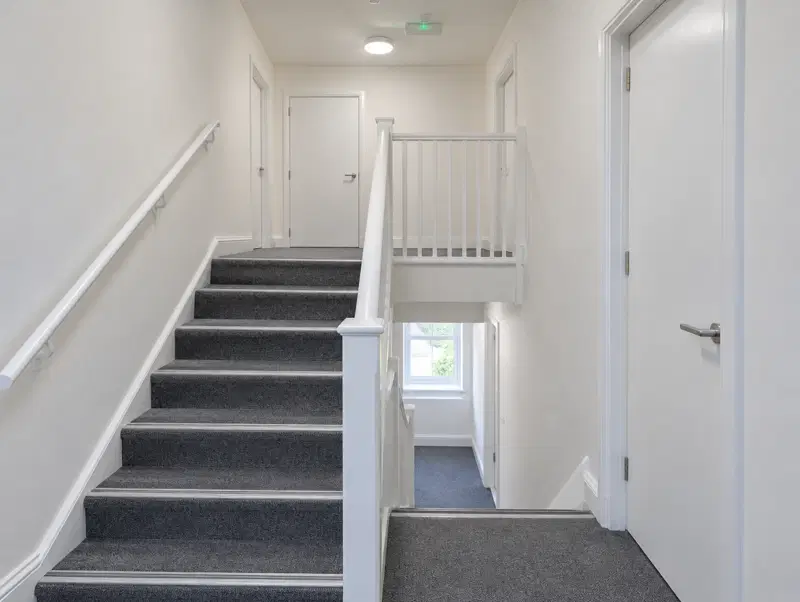
What do HMO fire safety upgrades include?
- Works priced against your fire risk assessment
- Interlinked smoke and heat detection
- Fire doors with closers and seals
- Fire-resisting linings to the escape route
- Fire stopping of service holes
- Emergency lighting where needed
- Thumb-turn locks on exit doors
- Commissioning certificates and a handover pack
When do landlords need it?
- A fire risk assessment has listed actions
- A council inspection or licence condition
- Converting a house to an HMO
What rules apply in each UK nation?
The law differs between England, Wales, Scotland and Northern Ireland, and councils publish their own HMO standards on top. These are the points that usually matter for this work.
England
- Fire precautions follow a risk assessment; the LACORS Housing – Fire Safety guide (2008) is guidance, not law, but many councils base their standards on it.
- Mandatory HMO licence for 5 or more people in 2 or more households (since October 2018); councils can add additional licensing for smaller HMOs.
- Building regulations cover structural changes, new partitions, ensuite drainage, fire-resisting construction and notifiable electrical work.
- Smoke alarms on every storey with living accommodation and CO alarms by fixed combustion appliances (other than gas cookers) are required by law.
Wales
- Fitness for human habitation rules require mains-powered, interlinked smoke alarms on every storey and CO alarms where there is a gas, oil or solid-fuel appliance.
- Mandatory licence for HMOs with 3 or more storeys and 5 or more people in 2 or more households; Wales did not adopt England’s 2018 change.
- Building regulations cover structural work, partitions, drainage, fire-resisting construction and electrics; confirm with building control whether the conversion is a material change of use.
- Council HMO standards and the fire risk assessment set detection, fire doors and escape routes.
Scotland
- The tolerable standard requires interlinked smoke alarms in the main living room and circulation spaces and a heat alarm in the kitchen; licensed HMOs must meet the council’s higher standard.
- Every HMO needs a council licence: 3 or more people who are not all from one or two families, sharing basic amenities. Licences last up to 3 years.
- A building warrant may be needed for a change of use or for installing a fire alarm system; check with the council’s building standards service.
- Councils set HMO fire standards through licence conditions, often including emergency lighting in larger HMOs.
Northern Ireland
- The NIFRS HMO Fire Safety Guide (July 2026) usually expects Grade D1 interlinked detection in smaller shared houses and a Grade A system with more than 6 occupants or over 200 m².
- A licence is needed where 3 or more people forming more than two households live as their main home and pay rent; the NI HMO Unit at Belfast City Council licenses for every council.
- New HMOs need building control approval as well as planning permission.
- Doors on protected routes are typically FD30 or FD30S, self-closing on three hinges; emergency lighting is required in HMOs of 4 or more storeys.
All HMO rules for Northern Ireland
How much do HMO fire safety upgrades cost?
| Item | UK typical | Per |
|---|---|---|
| Interlinked mains alarm system (Grade D type), small HMO (our estimate from installer guides) | £800 – £2,000 | house |
| Panel alarm system (Grade A type), larger HMO | £1,750 – £4,500 | house |
| FD30S fire door leaf into an existing frame, with seals, closer and hinges, fitted | £300 – £600 | door |
| New FD30S fire doorset with frame, fitted | £600 – £1,300 | door |
| Protected route upgrades: fire-resisting linings, fire stopping, lighting (three-storey house, our estimate) | £2,000 – £6,000 | house |
Typical time on site: 3–10 working days. Your fixed price follows a site visit; use the guide-price tool for a figure for your house.
How the job runs
- Free site visit and measured survey.
- Itemised written quote and programme.
- Works with one point of contact and photo updates.
- Handover with certificates, drawings and photos.
Questions about HMO fire safety upgrades
What fire safety does an HMO legally need?
The law asks for the house to be reasonably safe, with suitable fire precautions for its size and layout. The detail usually comes from a fire risk assessment and council guidance, so the right answer for a three-storey seven-bed house is very different from a two-storey three-bed one.
Who writes the fire risk assessment?
You arrange it, through a competent assessor. We price and carry out the works it recommends and give you the evidence.
Do all doors need to be fire doors?
Not always. Guidance usually focuses on doors to rooms that open onto the escape route. The assessment sets out which doors need upgrading.
Can you upgrade existing doors?
Sometimes, if the door and frame are sound. Often a certified fire door set is the cheaper and more reliable option.
Related services
- Fire alarm and detection systems
- Fire doors
- Escape routes, emergency lighting and fire stopping
- Licence condition and schedule-of-works
- Rewires and EICR remedials
- Large HMO conversions (7+ sharers)
Where we work
Choose a nation and area for local rules, postcodes and regional prices.
England
- Bedfordshire
- Berkshire
- Bristol
- Buckinghamshire
- Cambridgeshire
- Cheshire
- Cornwall
- County Durham
- Cumbria
- Derbyshire
- Devon
- Dorset
- East Riding of Yorkshire
- East Sussex
- Essex
- Gloucestershire
- Greater London
- Greater Manchester
- Hampshire
- Herefordshire
- Hertfordshire
- Isle of Wight
- Kent
- Lancashire
- Leicestershire
- Lincolnshire
- Merseyside
- Norfolk
- North Yorkshire
- Northamptonshire
- Northumberland
- Nottinghamshire
- Oxfordshire
- Rutland
- Shropshire
- Somerset
- South Yorkshire
- Staffordshire
- Suffolk
- Surrey
- Tyne and Wear
- Warwickshire
- West Midlands
- West Sussex
- West Yorkshire
- Wiltshire
- Worcestershire
Wales
- Blaenau Gwent
- Bridgend
- Caerphilly
- Cardiff
- Carmarthenshire
- Ceredigion
- Conwy
- Denbighshire
- Flintshire
- Gwynedd
- Isle of Anglesey
- Merthyr Tydfil
- Monmouthshire
- Neath Port Talbot
- Newport
- Pembrokeshire
- Powys
- Rhondda Cynon Taf
- Swansea
- Torfaen
- Vale of Glamorgan
- Wrexham
Scotland
- Aberdeen City
- Aberdeenshire
- Angus
- Argyll and Bute
- City of Edinburgh
- Clackmannanshire
- Dumfries and Galloway
- Dundee City
- East Ayrshire
- East Dunbartonshire
- East Lothian
- East Renfrewshire
- Falkirk
- Fife
- Glasgow City
- Highland
- Inverclyde
- Midlothian
- Moray
- Na h-Eileanan Siar
- North Ayrshire
- North Lanarkshire
- Orkney Islands
- Perth and Kinross
- Renfrewshire
- Scottish Borders
- Shetland Islands
- South Ayrshire
- South Lanarkshire
- Stirling
- West Dunbartonshire
- West Lothian